
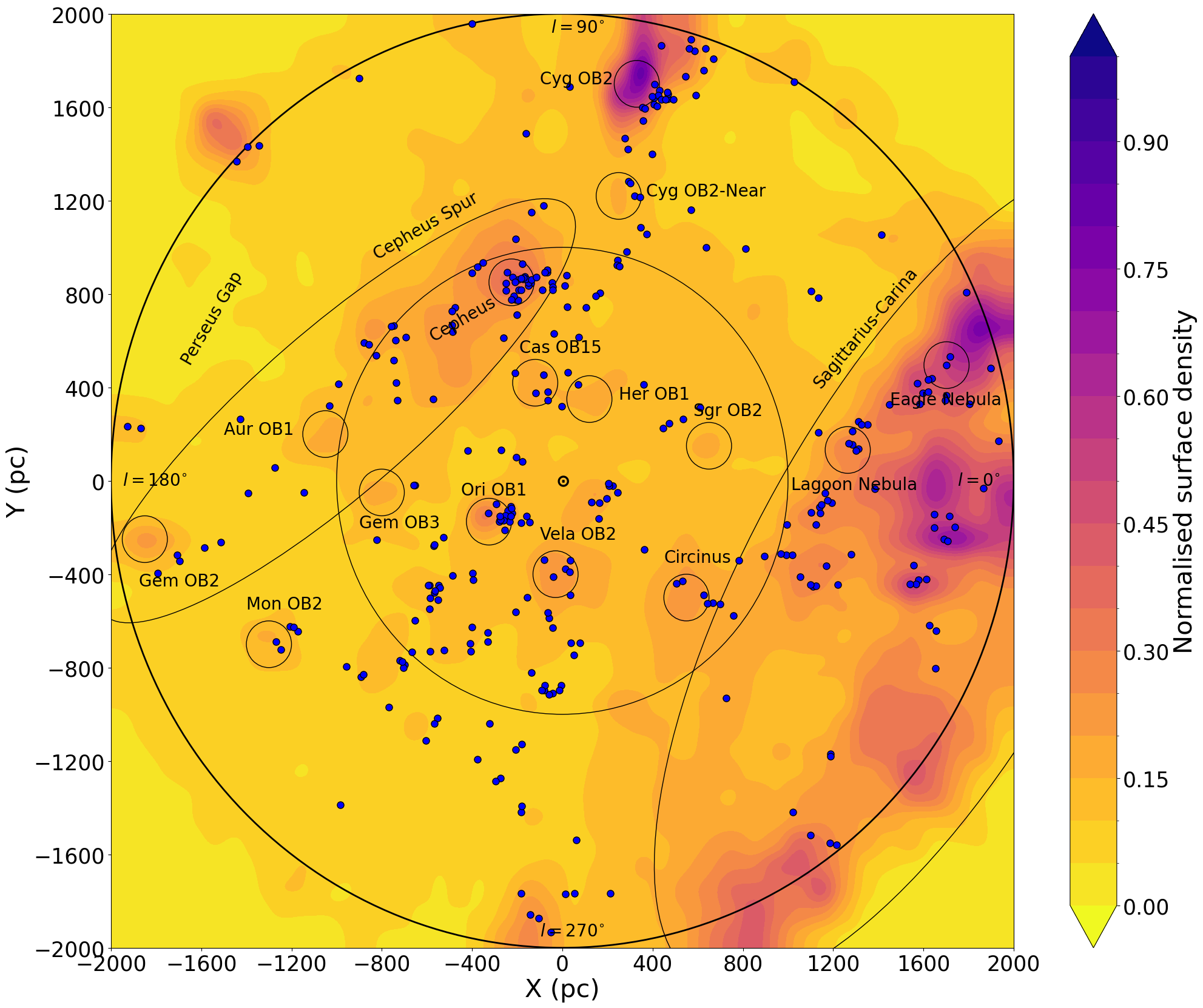
Gaia map of the OB stars at 2 kpc from the Sun.
Credits:NASA/JPL-Caltech/GSFC
Alexis Quintana
Abstract
OB stars are vital to study star formation, stellar multiplicity and stellar feedback, and are also fundamental tracers of Galactic structure. At the dusk of the Gaia DR3 era, a new accurate, complete catalogue of OB stars based on Gaia data therefore appears timely.
In this work, we have applied a Bayesian astro-photometric tool (SED fitter) to identify and characterize a population of 105,971 O- and B-type stars within 2 kpc of the Sun. Our map unveils a complex view of the young stellar populations across the Milky Way’s thin disk. Their highly inhomogeneous distribution reveals a sharp contrast between the Galactic Anticentre and Centre directions, with prominent large-scale features such as the Cepheus Spur, the Giant Oval Cavity, and a segment of the Sagittarius-Carina spiral arm.
We have quantified the level of clustering amongst OB stars by comparing them with the list of open clusters (Hunt & Reffert 2023, 2024). In doing so we observe that the hotter stars tend to sit in more concentrated regions. Additionally, the clustered population of OB stars is characterized by a near constant decrease as a function of increasing Galactocentric radius, compatible with models of star formation in disk galaxies.
We have also derived new values of the star formation (∼14,000 M⊙/Myr), surface density star formation rate (1100 M⊙/Myr/kpc2) and core-collapse supernova rate (80–100 per Myr) within this volume. Applying a Galactic model, we extrapolated to estimate a Milky Way star formation rate of ∼0.8 M⊙/yr) and a core-collapse supernova rate of 0.5–0.6 per century, slightly larger than our previous estimates. Likewise, we derived a Near-Earth (within 20 pc) ccSN rate of 2.5–3.5 per Gyr, reinforcing the scenario where a past mass extinction event on Earth could have been caused by the intense UV radiation of a nearby supernova explosion. Finally, thanks to our refined supernova model we have exploited, we have estimated a rate of stellar back hole formation of ∼0.1 per century, leading to an estimated number of ∼13 million stellar black holes in the Milky Way.