Supriya Dayananda
Abstract
The solar corona is a hot, tenuous, and highly structured plasma whose magnetic and velocity fields are challenging to determine from observations.
Coronal spectral lines encode this information in their intensity and polarization, but interpreting these observables requires accounting for several coupled physical processes, including anisotropic radiation pumping, collisions, the Hanle and Zeeman effects, and Doppler dimming. The interpretation is further complicated because the observed emission is integrated along the line of sight through regions with different plasma conditions.
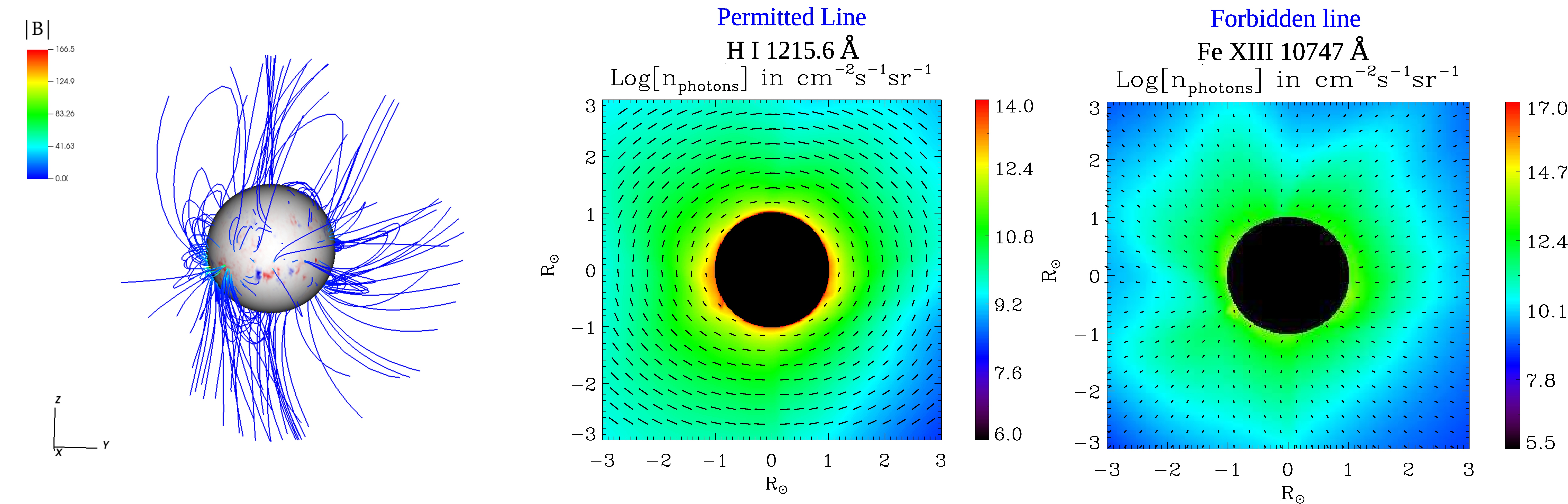
In this talk, I will introduce forward modelling as a bridge between three-dimensional models of the solar corona and spectropolarimetric observations. I will present P-CORONA, a spectral-synthesis code developed to calculate the emergent Stokes signals of permitted and forbidden coronal lines while consistently treating symmetry breaking by magnetic fields and non-radial plasma motions.
I will then illustrate what this approach reveals through three applications focused on Doppler-dimming effects. Specifically, I will present results from our investigations on the influence of the non-radial solar-wind velocities on several coronal lines: the ultraviolet Ly-α lines of H I at 1216 Å and He II at 304 Å, the extreme-ultraviolet Ne VIII line at 770 Å, and the infrared Fe XIII lines at 10747 and 10798 Å.
Through their motion relative to the solar disk, non-radial solar-wind velocities can produce Doppler dimming or brightening in the radiation field as seen by the coronal atoms. This can modify the anisotropy and symmetry of the incident radiation, thereby affecting both the observed intensity and polarization signals.
Although Doppler dimming is generally expected to influence permitted UV lines illuminated by strong emission profiles from the underlying solar disk, we also investigated whether it has a measurable effect on forbidden IR lines, for which the disk radiation is spectrally flat.
These studies demonstrate how forward modelling can quantify the sensitivity of different coronal lines to velocity fields and identify their potential for velocity diagnostics.
Accounting for these velocity-induced effects is essential for accurately modelling the intensity and polarization signals and for avoiding biases when inferring magnetic fields.