
260715.ProbingPlanetaryEvolution-2
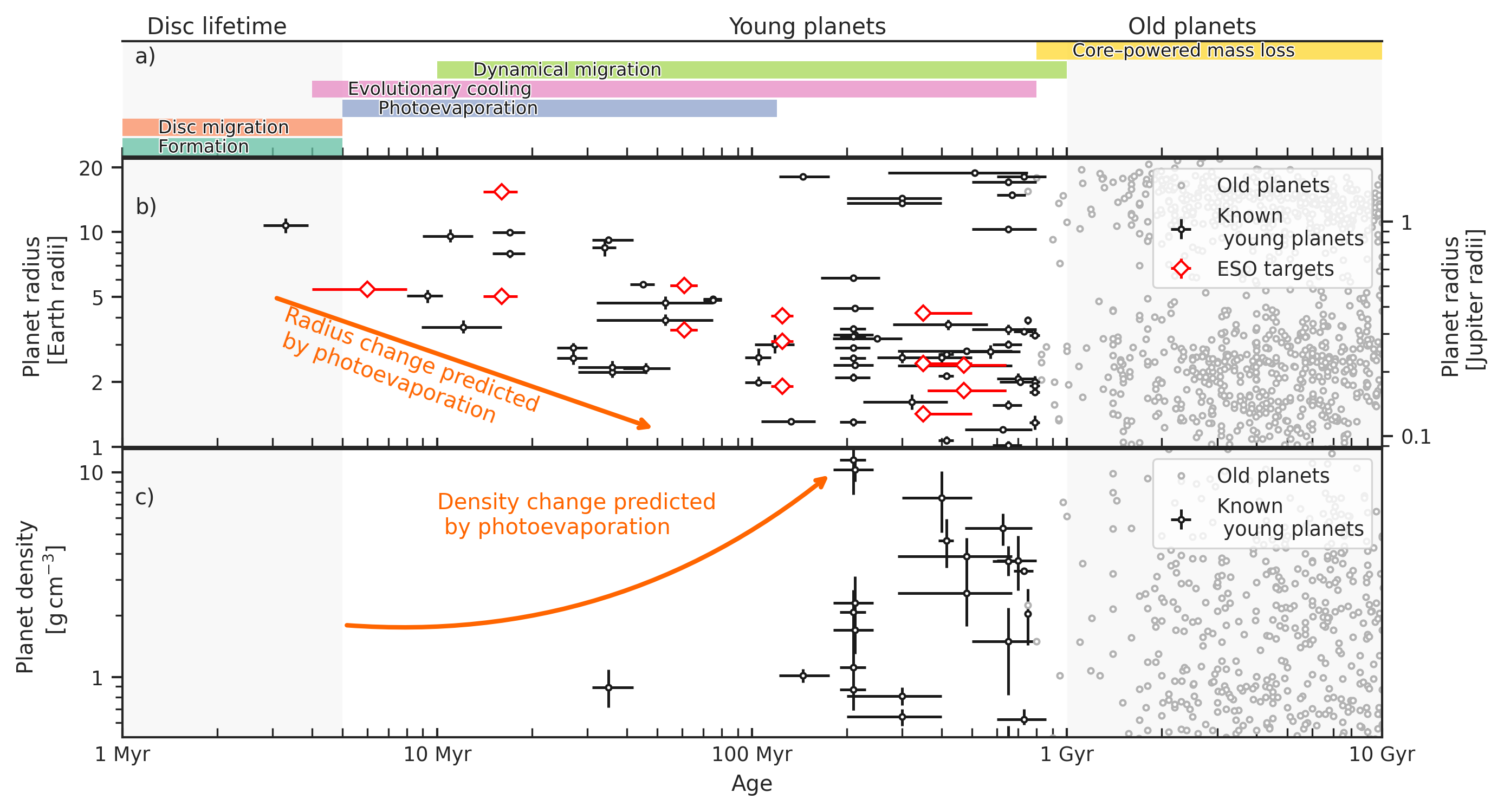
Planet radius and planet density vs planet ages
Oscar Barragan
Abstract
Young exoplanets, those within the first few hundred million years after formation, provide critical snapshots of the processes shaping planetary evolution.
However, their density characterization is hindered by strong, time-variable stellar activity that dominates radial velocity (RV) measurements. Complicating their mass, hence density, measurements.
We present a framework for mitigating stellar variability, showing that contemporaneous high-cadence photometry can outperform traditional spectroscopic diagnostics in modelling high-precision RVs. This enables the detection of planetary signals significantly smaller than the stellar activity amplitude and allows robust mass measurements for young transiting planets.
This approach is being applied within an ongoing ESO Large Programme (>250 hours) targeting 13 transiting planets in 7 young stellar systems, effectively doubling the current sample of well-characterised young transiting planets. By expanding this sample, the program will map the mass-radius-age parameter space at early times and provide key empirical constraints on atmospheric evolution processes, including photoevaporation and core-powered mass loss.
In particular, it will enable direct tests of the origin and early evolution of population-level features such as the Neptunian desert. These results highlight the critical synergy between photometric surveys (e.g. NGTS, PLATO) and state-of-the-art RV instruments, and provide a scalable pathway to overcoming stellar activity in the study of young planetary systems.