
Fulvia Pucci
INAF - IAPS
Abstract
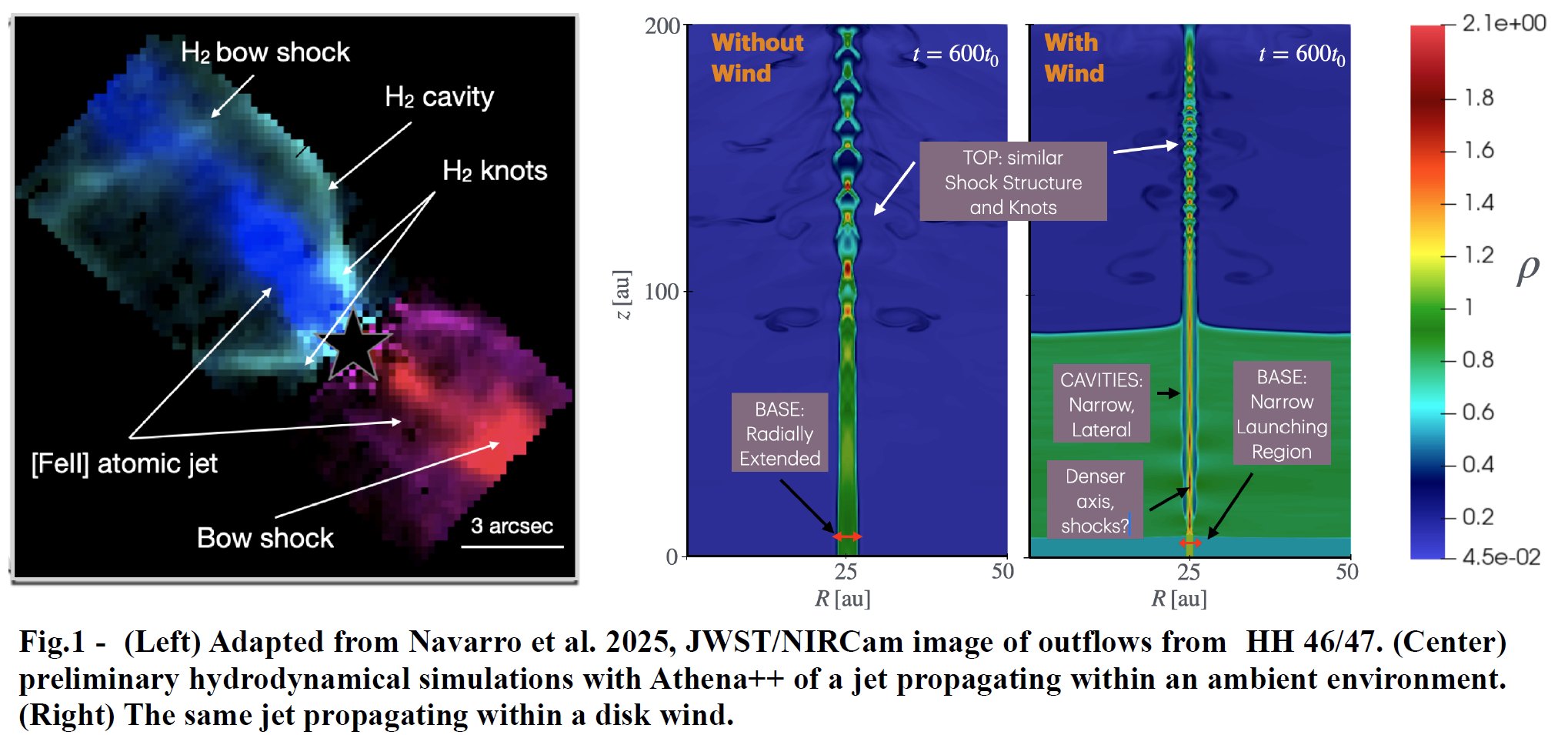
From protoplanetary disks (PPDs) to active galactic nuclei, accretion onto a central object is characterized by outflows, despite physical conditions that differ by many orders of magnitude. These outflows are observed either as highly collimated jets or as wider-angle, less collimated disk winds. Independently of the launching mechanism, the outflowing plasma converts a significant fraction of its magnetic and kinetic energy into heat and particle acceleration. Among the processes responsible for this conversion, magnetic reconnection and shocks are two of the most efficient. In this talk, I will discuss a model of fast and efficient magnetic reconnection and show how it can play a key role in two very different regimes: as a heating mechanism in magnetocentrifugal winds from PPDs, and as a source of non-thermal particles in relativistic astrophysical jets, where particle-in-cell simulations of reconnection, and multi-plasmoid generation, account for the hard particle spectra and the fast flaring observed in blazars. I will then turn to shocks and to jet morphology, and argue that a detailed understanding of the shock structure from simulations is needed to connect the observed emission to the underlying jet properties, in particular in light of recent James Webb Space Telescope (JWST) observations of protostellar jets (see Fig. 1).
Local contact person: Claudia Maria Raiteri