
Giulia De Somma
INAF-Astronomical Observatory of Capodimonte
261201.ClassicalCepheidPulsationModelsOnTheEveOfGaiaDR4
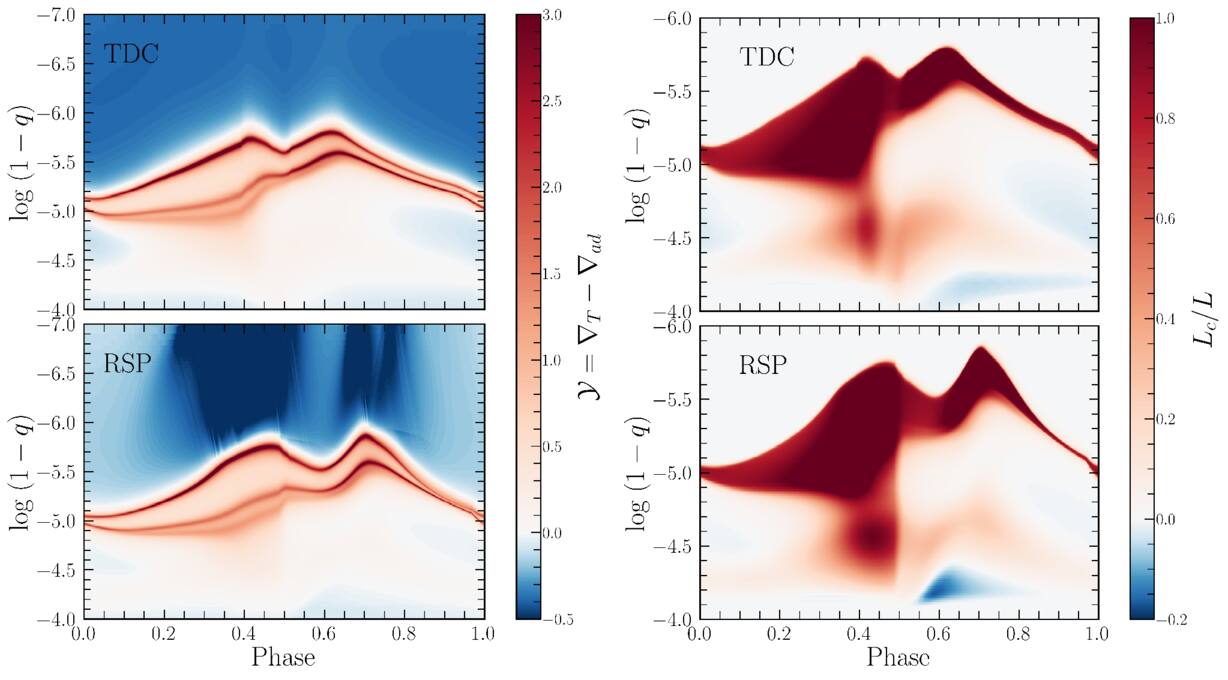
Figure 8. Profiles of the stellar structure across the pulsation cycle for the MESA-TDC and MESA-RSP loaded from an identical initial model generated in MESA-RSP. All panels illustrate the transformed logarithmic fractional mass coordinate log(1 − q) (where q = M/M⋆) versus pulsation phase. Left panels are colored by the superadiabatic gradient and right panels are colored by the fractional convective luminosity Lc/L. Dark red regions generally mark the boundary of the hydrogen-ionization bump in the left column and convective regions in the right column. Model properties are provided in Table 3. Both models adopt αm = 0.25.
Abstract
Classical Cepheids are fundamental calibrators of the cosmic distance scale and powerful tracers of young stellar populations.
Gaia astrometry and multi-epoch photometry provide a unique benchmark for testing Classical Cepheid pulsation models and assessing the impact of their physical assumptions on distance and age determinations.
Recent results based on an extended grid of nonlinear, convective pulsation models, computed by varying the mass-luminosity relation, the efficiency of convection, and the chemical compositions, will be presented.
n the Gaia photometric system, these models provide new Period-Luminosity-Color, Period–Wesenheit, and metallicity-dependent relations.
Their application to Galactic Classical Cepheids allows theoretical parallaxes to be directly compared with Gaia measurements, providing an independent assessment of the Classical Cepheid distance scale and systematic effects in Gaia astrometry.
Combined with stellar evolution predictions, the models also provide metallicity-dependent Period-Age relations for investigating the recent star-formation history of the Milky Way and nearby galaxies.
On the eve of the Gaia DR4 release, the expected improvements offered by the new astrometric and photometric data will be discussed.
The extension of the same theoretical framework to Rubin-LSST, JWST and Roman will also be presented, highlighting its implications for the extragalactic distance scale and measurements of the Hubble constant.
See also:
Local contact person: Mariateresa Crosta mariateresa.crosta@