
Artist’s impression of the multi-planet system around the K-dwarf star HIP-99452.
By INAF-OATo
A team of researchers led by INAF-Osservatorio Astrofisico di Torino has discovered and characterized a particularly interesting exoplanet system around the bright (V=7.3 mag) and nearby (d=20 pc) K dwarf star HIP 99452, thanks to 141 high-precision radial-velocity measurements collected with the HARPS-N (High Accuracy Radial velocity Planet Searcher for the Northern Hemisphere) spectrograph at the Telescopio Nazionale Galileo, in the Canary islands.
The researchers turned their attention to this star because a transiting planet candidate with a radius smaller than that of Neptune (sub-Neptune) had been discovered orbiting around it with a period of about 13 days by the NASA Transiting Exoplanet Survey Satellite (TESS) space mission. By analyzing both the TESS photometry and the HARPS-N radial velocities, they were able to confirm the planetary nature of the transiting candidate, and determine its radius, mass, and bulk density to be ~2.9 REarth , ~5 MEarth, and 1.2 g cm-3, respectively. The relatively low bulk density implies that the planet, named TOI-5789c, must possess a significant atmosphere, which might be hydrogen-rich or water-rich. These two different atmospheric compositions correspond to different planet formation locations, that is within or beyond the water condensation front at ~1-3 AU in the primordial protoplanetary disk, before the planet started migrating towards its host star.
Atmospheric characterization with both the James Webb Space Telescope (JWST) and, in the future, Ariel (Atmospheric Remote-sensing Infrared Exoplanet Large-survey) will help us clarify the origin and nature of the sub-Neptune TOI-5789c and, maybe, of sub-Neptunes in general. The still elusive answer to the question of whether sub-Neptune planets are mainly water-poor or water-rich has profound implications for models of planet formation. “JWST observations in the near future may reveal the true planet composition, which cannot be uniquely determined from the measurement of the bulk density alone. TOI-5789c is currently the most favorable small planet for atmospheric characterization through transmission spectroscopy with the JWST, thanks to the ideal combination of planet parameters and brightness of the host star“, says Dr. Aldo S. Bonomo, researcher at INAF and first author of the paper.
Thanks to careful analyses of the HARPS-N RVs, the team also discovered three low-mass siblings of TOI-5789c, one in an inner orbit with a period of 2.8 days (TOI-5789b), and the other two in outer orbits with periods of 30 and 63 days (TOI-5789d and e), respectively. “The more HARPS-N radial velocities we were taking, the more signals we were finding. We had to more than double the number of measurements initially planned in order to properly characterize the architecture of this system“, explains Luca Naponiello, researcher at INAF and second author of the paper.
The TOI-5789 planets have relatively high mutual inclinations as only planet c is transiting, unlike the majority of compact and flat multi-planet systems found by the NASA Kepler space telescope. This makes the origin of this planetary system even more intriguing, as it may have gone through a phase of dynamic instability, leading to the ejection or collision of one or more planets before the system reached a stable configuration.
For more information, read the article:
“The GAPS programme at TNG. LXXI. A sub-Neptune suitable for atmospheric characterization in a multiplanet and mutually inclined system orbiting the bright K dwarf TOI-5789 (HIP 99452)”, published in Astronomy & Astrophysics.
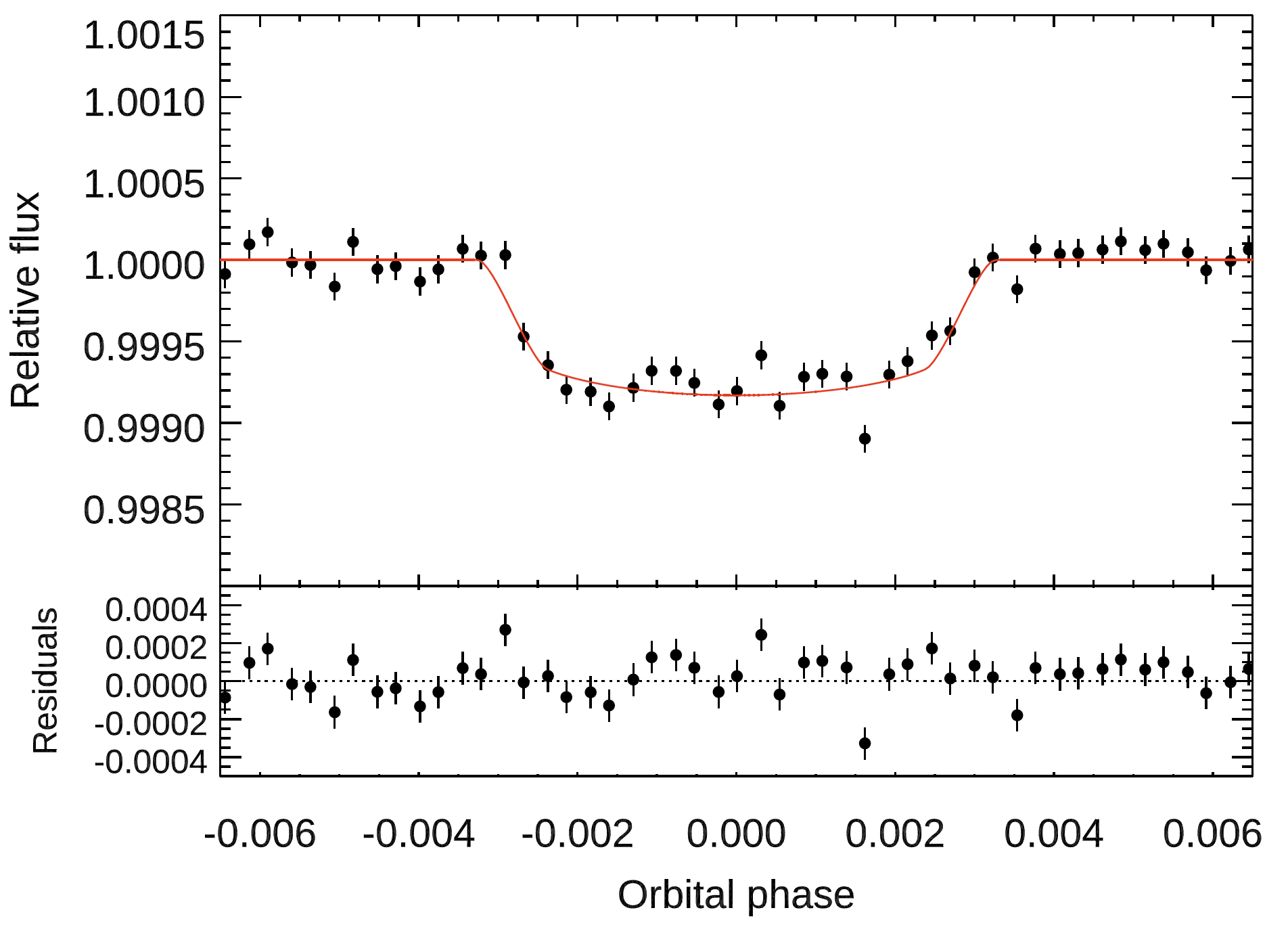
108 Transits of the planet TOI-5789c observed by the TESS satellite and shown in phase with the planet's ephemeris.
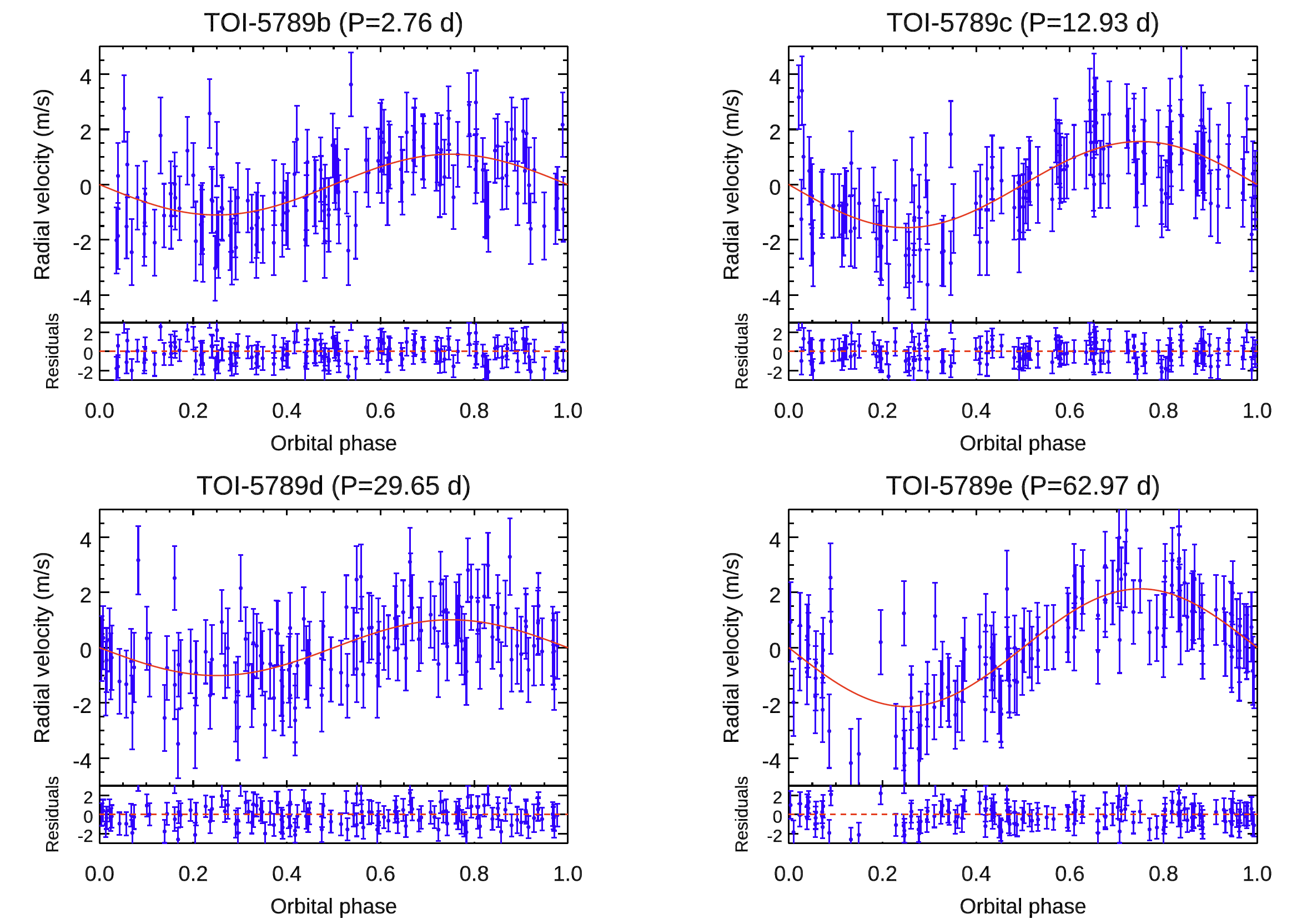
Radial signals of the four planets TOI-5789b (top left panel), c (top right panel), d (bottom left panel), and e (bottom right panel) in the HARPS-N data, phased with the planetary ephemeris.
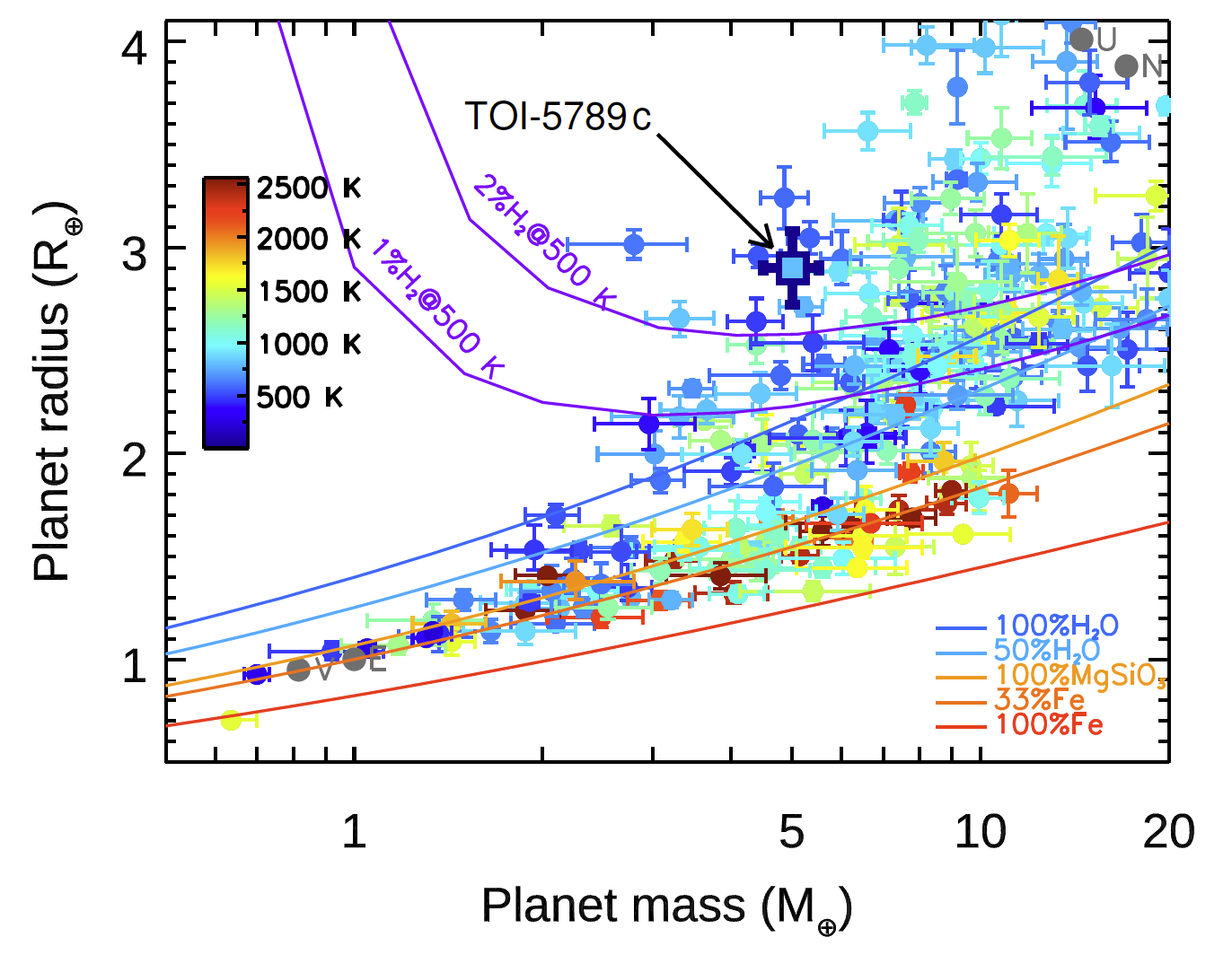
Mass-radius diagram of the known small planets (Rp ≤ 4 REarth), where the color depends on the equilibrium temperature (the red and blue circles indicate the hottest and coldest planets, respectively). The solid lines show different planetary composition curves (see the legend). The gray circles indicate Venus (V), Earth (E), Uranus (U), and Neptune (N). TOI-5789 c is indicated by a square.