
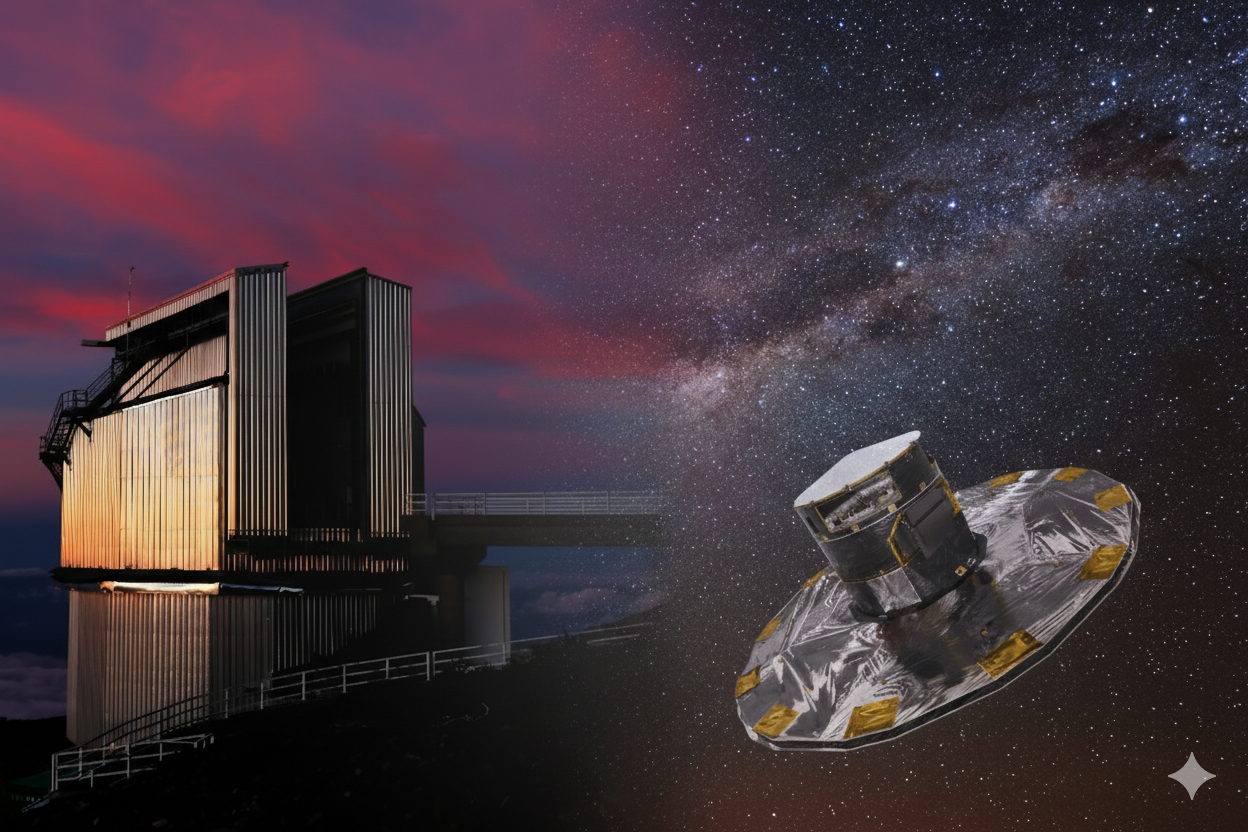
by Matteo Pinamonti
An international team led by Matteo Pinamonti of the Observatory of Turin has characterized Gaia-6 B, a rare brown dwarf orbiting the star HD 128717, by combining data from the Gaia mission with observations from the Telescopio Nazionale Galileo. With a mass about 20 times that of Jupiter, the object stands out for its extremely eccentric orbit and an orbital period of approximately 9.4 years, among the most extreme ever observed for an object of this class.
The study has clarified an apparent discrepancy in the previous orbital solution from Gaia DR3, which had measured a much shorter period and a less eccentric orbit, showing that this difference arises from the intrinsic difficulty of reconstructing orbits with periods longer than the time span covered by the observations. Thanks to high-precision monitoring with the HARPS-N spectrograph, the researchers were able to reliably constrain the shape and parameters of Gaia-6 B’s orbit, providing a more complete picture of the system.
The results raise new questions about the formation of objects at the boundary between giant planets and brown dwarfs, as well as the origin of such extreme orbits, which remains not fully explained. The study also highlights the value of the synergy between space-based astrometry and ground-based observations, and the key role of future Gaia data releases in further improving our understanding of complex systems like this one.
The article was published on A&A.