
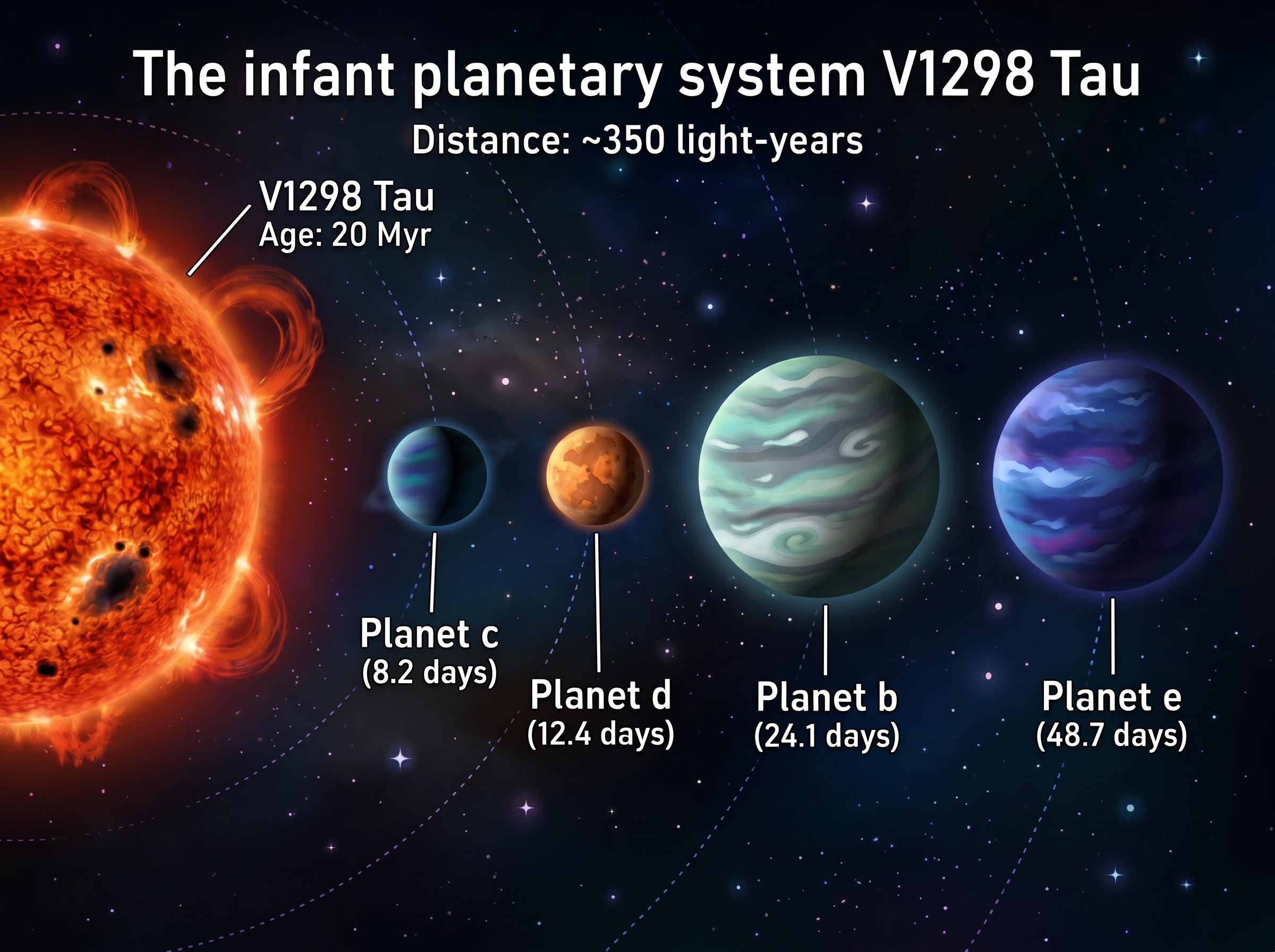
Cartoon of the planetary system orbiting V1298 Tau.
Mario Damasso
Physical and architectural properties of young planetary systems can look very different from those of the mature population, offering a rare opportunity to investigate how planets form and evolve before their architecture settles into its final configuration. One particularly interesting example is V1298 Tau, a star approximately 20 million years old that hosts four confirmed transiting planets.
Two recent studies led by Mario Damasso (INAF-OATo) have tackled the complex challenge of characterizing this infant system, combining long-term radial-velocity mass measurements with a multi-wavelength campaign to understand the star’s intense magnetic environment.
In the first study, conducted within the Global Architecture of Planetary Systems (GAPS) programme, the team analysed more than 380 high-resolution spectra collected with HARPS-N at the Telescopio Nazionale Galileo over four and a half years. The goal was to constrain the planets’ masses using the tiny changes in the star’s motion caused by their gravitational pull, but the host star’s high activity made this extremely difficult. The inferred masses depend heavily on the data-analysis method and stellar magnetic activity models. In some models, the outermost planets b and e could be much more massive than estimates based on a different technique (transit-timing variations), while the analysis provided RV-based updated upper mass limits for the innermost planets c and d.
To better characterize the extreme stellar environment complicating these measurements, the second study involved a multi-wavelength campaign using the Karl G. Jansky Very Large Array (JVLA) and the Swift satellite conducted over a few months. Monitoring the star in radio, X-ray, and near-ultraviolet bands revealed highly variable emissions, including the capture of the decay phase of a prominent X-ray stellar flare. The radio flux switches between high and low states in a matter of days or hours, showing a moderate correlation with optical light curves that suggests the emission is modulated by the star’s rotation and active magnetic spots. Ultimately, understanding these complex magnetic phenomena is an essential step toward unraveling the early evolutionary stages of planetary systems.
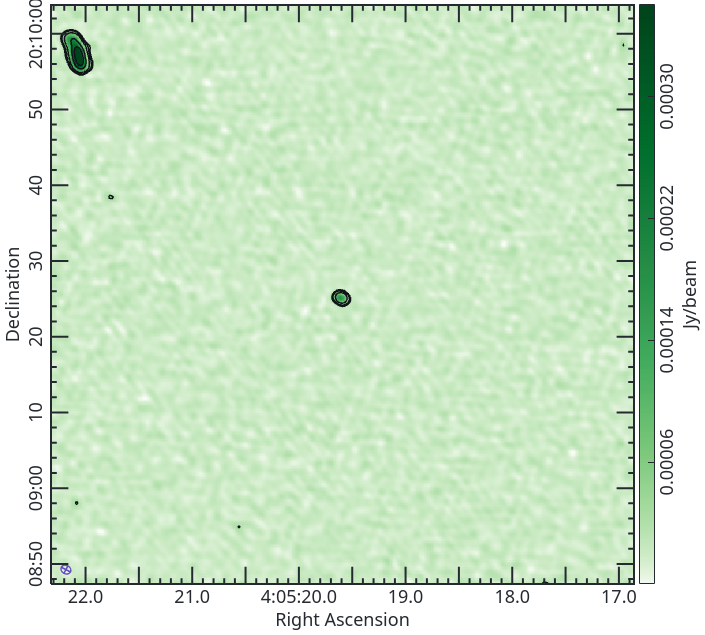
Example of JVLA Stokes I image, centered on V1298 Tau’s position, showing strong emission coming from the star.