
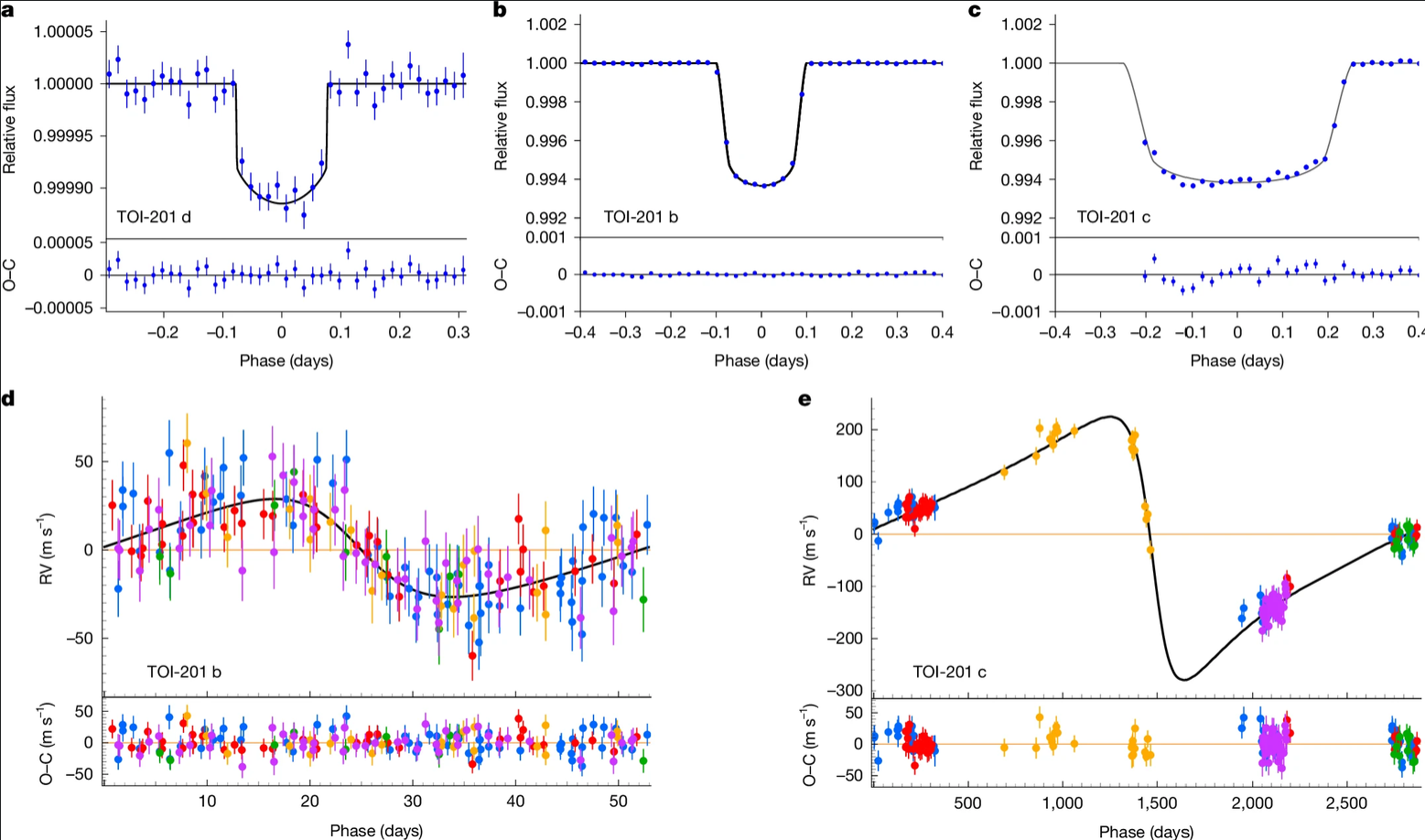
Figure 1. Transit observations of TOI-201 b, c, and d (top panels) and radial velocity measurements of the host star (bottom panels). The points represent the collected data, while the solid lines show the model that best reproduces the observations. Error bars indicate measurement uncertainties.

Figure 2. Artistic rendering of the TOI-201 system. In the foreground is the massive brown dwarf TOI-201 c, followed by the moderately warm Jupiter-like planet TOI-201 b (subject to strong gravitational perturbations), the super-Earth TOI-201 d, and finally the host star. Credit: INAF / generated with Gemini AI.
by Luca Naponiello and Aldo Bonomo
An international team, with a major contribution from Italy and INAF, has characterized the exoplanetary system TOI-201, discovering within it the longest-period transiting brown dwarf with a measured mass, orbiting its host star every approximately eight years. The study reveals a hierarchical and coplanar system in which the presence of an eccentric brown dwarf redefines the stability boundaries for the inner super-Earth and Jupiter-like planet.
Born from the detection of a single and exceptionally rare “monotransit” event in data from NASA’s TESS satellite, an international collaboration has unveiled an extraordinary planetary system that sheds new light on the mechanisms governing planet formation and evolution. The study, published today in the prestigious journal Nature, bears a strong Italian imprint. Among the leading authors is Luca Naponiello, researcher at INAF – Turin Astrophysical Observatory and second author of the paper, together with fellow researchers Aldo Stefano Bonomo and Alessandro Sozzetti from the same institute, as well as colleagues from the Universities of Milan and Rome Tor Vergata.
At the heart of the discovery lies TOI-201 c, a brown dwarf, a failed star occupying the mass range between giant planets and low-mass stars, with a mass of about 16.5 Jupiter masses. It is the transiting object with the longest known orbital period, just under eight years, for which a mass measurement has been obtained. Because of its large separation from the host star, the probability of such an object passing directly in front of the stellar disk as seen from Earth is quite low.
The system also hosts two planets on inner orbits, both transiting and perfectly aligned (coplanar) with the brown dwarf’s orbital plane: a likely rocky super-Earth (TOI-201 d) with an orbital period of only 5.8 days, and a gas giant (TOI-201 b) on an intermediate, moderately eccentric orbit of about 53 days. The strong gravitational interaction between the brown dwarf and the giant planet produces significant perturbations in the latter’s orbit, revealed through large variations in its transit times.
Using radial velocity measurements, the researchers determined the brown dwarf’s mass and found that it follows a highly elliptical orbit. This configuration would have allowed planets to form only in the innermost regions of the system, at distances smaller than that of Mars from the Sun. Owing to the brown dwarf’s strong gravitational influence, all outer regions are dynamically unstable. This result was made possible through a combined analysis of TESS transit photometry and high-resolution spectroscopic observations collected with several instruments at the European Southern Observatory (ESO).
According to the authors, the discovery adds a key piece to our understanding of planetary formation processes, demonstrating that planets can form and survive even in systems hosting very massive companions on highly eccentric outer orbits. The finding also challenges leading theoretical models, which generally predict that giant planets form in the outer regions of protoplanetary disks, beyond the water snow line located roughly 2–3 astronomical units from the host star, before migrating inward over time.
The discovery now paves the way for future characterization studies of the system. New spectroscopic observations will help determine the mass of the super-Earth, while astrometric data from the next Gaia mission data release will enable a full reconstruction of the brown dwarf’s three-dimensional orbit.