
260220.PROBA-3.ASPIICS
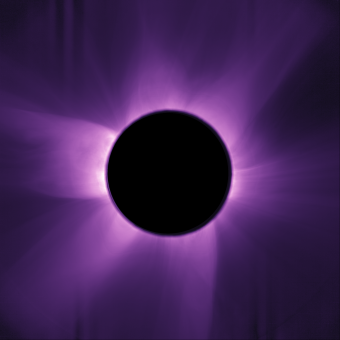
The Sun's inner corona, artificially colored to appear violet, in an image taken on May 23, 2025, by the ASPIICS coronagraph aboard Proba-3. This image shows the corona in polarized white light, captured using a special technique that allows scientists to separate the polarized light of the hot corona from the light scattered by interplanetary dust. Credits: ESA/Proba-3/Aspiics
Laurent Dolla
Abstract
Proba-3 is a mission dedicated to the in-flight demonstration of precise formation flying techniques and technologies, launched on 5 December 2024.
The Proba-3 mission consists of two small satellites in a highly elliptical orbit around the Earth.
During observation campaigns around the orbit apogee, the two satellites fly in a precise formation, producing a very long baseline solar coronagraph called ASPIICS (Association of Spacecraft for Polarimetric and Imaging Investigation of the Corona of the Sun).
One spacecraft carries the optical telescope, and the second spacecraft carries the external occulter of the coronagraph.
The inter-satellite distance of around 144 m allows observing the inner corona in eclipse-like conditions, i.e. close to the solar limb (1.1 Rs) and with very low straylight during nearly 6 hours in a row.
Images are produced in white light (total brightness), Fe XIV passband (530.45 nm), He I D3 passband (587.72 nm) and polarised brightness, at different respective cadence depending on the observing window (from 2 seconds to 15 minutes).
I will present the science operations, some key points of the instrument calibration, first results, and the synergies with other missions observing the corona, especially the Metis coronagraph onboard Solar Orbiter.