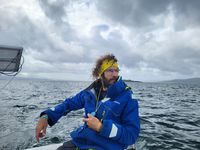
Dott. PAOLO GIACOBBE
My name is Paolo Giacobbe, and I am a staff researcher at the INAF-Turin Astrophysical Observatory.
I was born in Turin, where I completed my university studies, before earning my PhD in Trieste.
I fondly remember my PhD work on the APACHE project, an initiative with small telescopes in the Aosta Valley where I truly cut my teeth in the field. Through that experience, I understood that to reach a goal, you have to proceed inch by inch—and these inches must be gained at every step and in any direction, whether it’s learning how to deal with the screws of the instruments or with the physics of the problem.
As Al Pacino famously says in Any Given Sunday: “You find out that life is just a game of inches.”
CV Paolo Giacobbe
My research focuses on the detection and characterization of exoplanets, planetary systems, and their atmospheres, employing advanced spectroscopic, astrometric, and photometric techniques from both ground-based and space-borne observatories.
With a primary focus on exoplanetary atmospheric characterization, my work is supported by the study of planet-host stars, including the determination of stellar rotation and chemical composition, as well as the design and development of advanced data simulation and analysis pipelines for astronomical applications.
In this context, I am the creator and developer of GUIBRUSHR, a software package for analyzing high- and low-resolution spectroscopic data from both ground-based and space-based telescopes.
If you’re interested in this project, you can download the code here;
https://www.ict.inaf.it/gitlab/guibrushr/guibrushr
and read all the documentation here
https://guibrushr.readthedocs.io/en/latest/
Furthermore, I am actively involved in several major international and national collaborations. I am a member of the Gaia and Ariel space missions and participate in the PLATO working groups.
On the ground-based front, I am a member of the science team for ANDES, the high-resolution spectrograph for the Extremely Large Telescope (ELT), as well as the Italian GAPS (Global Architecture of Planetary Systems) project, which is centered on exploiting the GIANO-B and HARPS-N high-resolution spectrographs at the Telescopio Nazionale Galileo (TNG) in the Canary Islands.
I wrote these lines at the end of my PhD. I still feel the same way: